Conquering debt and retirement savings
Debt, But Still Saving: Smart 401(k) Moves When You Owe More Than You’d Like
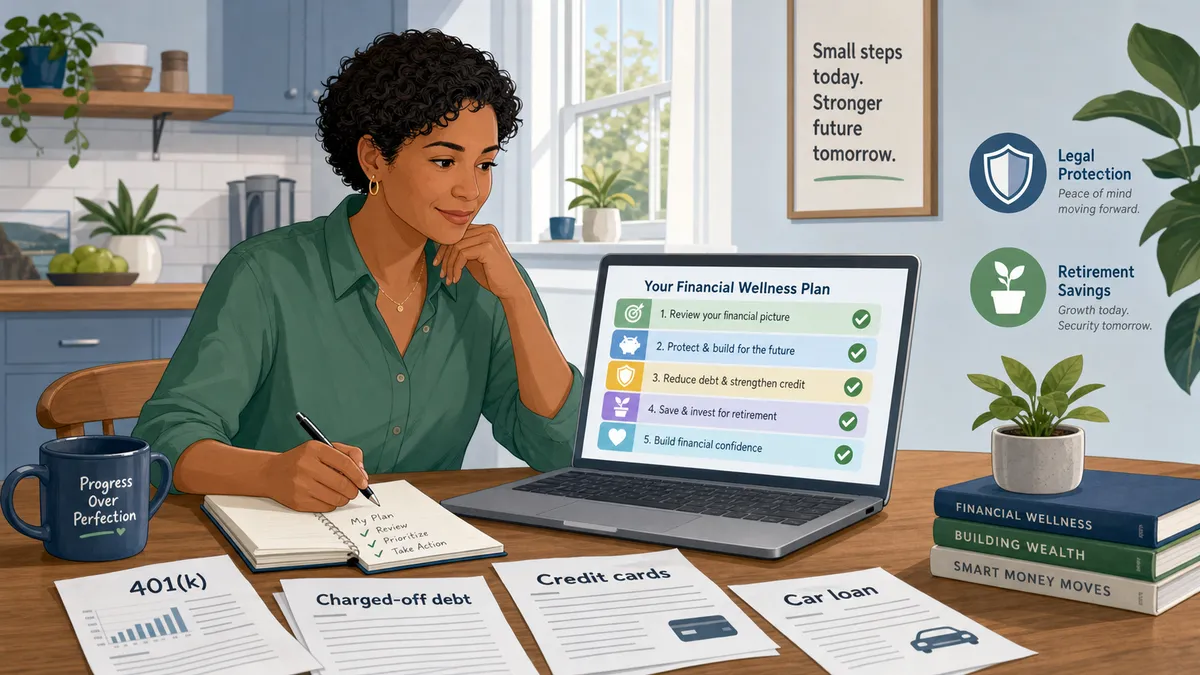
If you’ve got past‑due accounts, maybe even a charge‑off or a collection notice, and your credit score has taken a beating, it can feel like there’s no good move left. But even in that situation, you still have important choices: how you handle your charged‑off debts, your current balances, and your 401(k) can meaningfully change what happens next.
This guide is for you if you’re juggling:
- Credit cards
- Personal loans
- Car loans
- At least one account that’s been charged off or sent to collections
You’re not out of options. You just need a plan that deals honestly with the risks—lawsuits, new negative tradelines—and still protects your future.
Step 1: What “charged off” really means (and why it still matters)
When a creditor “charges off” a debt, it’s easy to hear that as “written off” or “gone.” In reality, it’s mainly an accounting move. The lender has decided it’s unlikely to collect in full, so it books the debt as a loss—but your legal obligation to repay doesn’t disappear.
Important implications:
- You still legally owe the balance unless it’s discharged (for example, in bankruptcy) or settled.
- The creditor or a debt buyer can keep trying to collect and, in many states, can still sue you for the debt as long as the statute of limitations hasn’t expired (commonly in the three‑to‑six‑year range, depending on the state and type of debt).
- A charge‑off usually shows up as a major negative mark on your credit report for up to seven years from the original delinquency date.
If the debt is placed with a collection agency or sold to a debt buyer, a separate collection tradeline can be added to your credit report on top of the original account. For many people, that combination—charge‑off plus collection tradeline—can seriously reduce your credit score and make it harder to get housing, loans, or even some jobs.
Paying or settling that charged‑off debt doesn’t erase the history, but it can help limit ongoing risk and is often a meaningful step toward rebuilding. And in the newer credit scoring models, paid charge-offs help your credit score.
Step 2: Keep minimums going and don’t create new problems
While you’re figuring out how to handle the charged‑off accounts, you want to stop new problems from piling up.
That means:
- Make at least the minimum payment on every active credit card, personal loan, and car loan.
- Stay current on essential bills like housing, utilities, food, and transportation.
Keeping active accounts out of default helps protect you from more charge‑offs, additional collections tradelines, and further damage to your credit report.
Step 3: Use pre‑tax 401(k) contributions and employer matches to your advantage
If your job offers a traditional 401(k) with a match, this is one of the few tools that doesn’t care about your credit score.
With a pre‑tax 401(k:
- Contributions come out of your paycheck before federal income tax is calculated, which lowers your taxable income.
- Because of the tax savings, your take‑home pay usually drops by less than the amount you contribute.
Quick example
Suppose you earn $60,000 a year and are in a 20% tax bracket.
- No 401(k: taxable income about $60,000 → roughly $12,000 in tax (20%) → ~$48,000 take‑home.
- Contribute 5% pre‑tax ($3,000): taxable income drops to $57,000 → about $11,400 in tax → ~$45,600 take‑home.
You put $3,000 into your 401(k, but your net pay only falls to around $2,400 because taxes went down.
Now add an employer match—say they match 50% of that 5%. That’s another $1,500 going into your account, for a total of $4,500 invested, while your paycheck shrinks by roughly $2,400. That’s a strong deal even if you’re in collections on other debts.
Step 4: Why paying charged‑off debt still matters—beyond “doing the right thing”
Given all this, you might wonder: “If the charge‑off is already on my report for seven years, why pay it?” There are real reasons:
- Lawsuit risk: As long as the debt is within the statute of limitations, a creditor or debt buyer can still sue you and, if they win, may be able to garnish wages or bank accounts depending on state law
- Additional tradelines: Collections activity can show up as separate tradelines from the collector, which can further hurt your score and make your credit report look worse to future lenders, landlords, and employers.[
- Peace of mind and future access: Getting the charged‑off debt resolved—whether paid in full or settled—removes the ongoing risk of legal action on that account and is often viewed more favorably than leaving it unresolved.
Paying the charged‑off debt that’s being collected by a legitimate agency or debt buyer is not just about checking a box; it’s about reducing legal and credit risk that can follow you for years.
Step 5: Balancing 401(k) saving with paying the charged‑off debt
So how do you juggle all these pieces: active debt, charged‑off accounts, and your 401(k? A practical way to think about it:
- Protect your 401(k match and take advantage of pre‑tax contributions.
If you can afford it, contributing enough to get the full match with pre‑tax dollars is still a strong move, even with charged‑off debt. You’re building something positive while lowering your taxable income. - Focus extra cash on high‑interest active debts and the charged‑off balance being collected.
High‑interest credit cards and expensive personal loans are bleeding cash each month; paying them down reduces ongoing cost. At the same time, putting money toward the charged‑off debt that’s within the statute of limitations can cut lawsuit risk and prevent further collection tradelines from appearing. - Keep car loans and lower‑rate personal loans current but reconsider extra payments.
If those debts carry lower fixed rates, you may get more benefit from using extra dollars to resolve charged‑off accounts and increase retirement savings than from paying those loans off early.
Step 6: Why not just drain the 401(k) to pay everything?
When you’re facing charged‑off debt, collection calls, and lawsuit risk, your 401(k) balance can look like an easy fix—either by cashing some of it out or taking a loan against it. Both options come with real trade‑offs.
If you withdraw money outright, the amount you take is usually taxed as income and may also face a 10% early‑withdrawal penalty if you’re under retirement age, so you lose a chunk immediately and forfeit future growth on those dollars. With a 401(k) loan, you’re pulling money out of your account, which cuts what’s invested and growing, and many people slow or pause new contributions while repaying the loan—further reducing long‑term savings. If you leave your employer or miss payments, any unpaid loan balance is typically treated as a taxable distribution: it’s offset against your 401(k), you owe income tax on it (and often a 10% penalty), and your remaining retirement balance permanently drops.
For most people, that’s why the safer path is to protect your pre‑tax contributions and employer match, then use a structured plan to pay or settle charged‑off and active debts over time, instead of turning retirement savings into a bailout that creates new problems down the road.
Step 7: A realistic plan for someone with charged‑off debt
Putting it all together, a practical roadmap might look like this:
- Make minimum payments on all active credit cards, personal loans, and car loans to stop new charge‑offs.
- Contribute enough to your 401(k to capture the full employer match if your budget allows, remembering that pre‑tax contributions soften the impact on take‑home pay.
- Direct extra cash toward:
- High‑interest active debts (credit cards, expensive personal loans), and
- The charged‑off debt is being collected to reduce lawsuit risk and limit additional negative tradelines.
- Keep lower‑rate car and personal loans current, but think carefully before sending extra if your charged‑off debt is still within the statute of limitations.
- Avoid tapping your 401(k) unless you’ve talked through all the tax, penalty, and long‑term consequences.
You can’t change the fact that a charge‑off happened—but you can decide whether it continues to threaten you with lawsuits and fresh negative marks, or becomes something you’ve faced, resolved, and moved past.