Beware of high interest rate loans
The Installment Loan That's Really a Payday Loan in a Suit
Most people know to run from a payday loan. The 400% APR, the two-week balloon, the storefront on the wrong side of the strip mall — it all reads as *danger* the second you see it.
But a growing category of online lenders has figured out that if they take the same math and stretch it over nine months instead of two weeks, borrowers don't feel the fangs. They call it an installment loan. It comes with a friendly dashboard, an auto-pay setup, and a payment schedule that looks manageable. The APR? Sometimes triple-digit. Sometimes quadruple.
I want to walk through two real loans — the kind we see every day in the collections world — and show you what's actually happening under the hood.
Loan #1: $800 borrowed. $1,702.33 owed.
Here's what the disclosure box on this loan looks like:
- APR: 225.00%
- Amount financed: $800.00
- Origination Fee: $40
- Finance charge: $902.33
- Total of payments: $1,702.33
Nine payments of $189 spread over nine months. On paper: manageable.
In reality: the borrower will pay $902.33 in interest to borrow $800. More interest than the loan itself.
Look at what happens on the very first payment:
- Payment amount: $189.14
- Interest portion: $143.01
- Principal reduction: $46.13
76% of the first payment goes toward interest. After writing that $189 check, the borrower has knocked $46 off an $800 balance. That's not paying down debt — that's renting money at 225% a year.
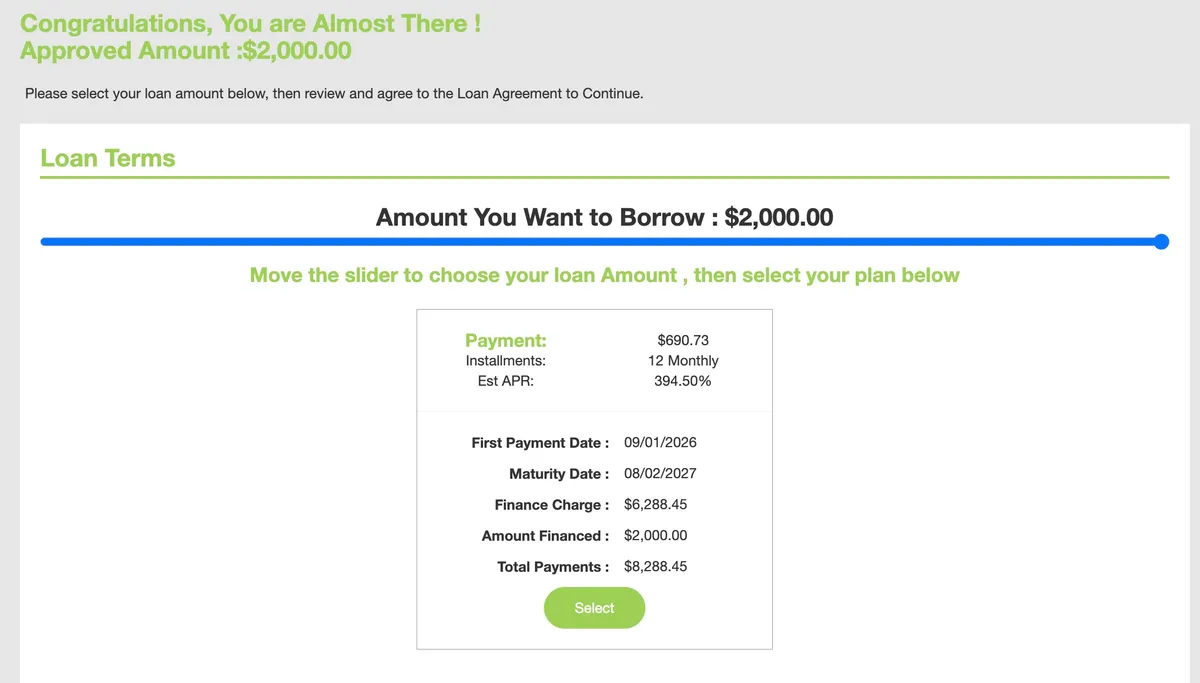
Loan #2: $2,000 borrowed. $8,288.45 owed.
394.50% APR, 12 months, $6,288.45 in finance charges
This one is worse. Daily interest rate of 1.08%. Twelve monthly payments. By the time the borrower is done, they've paid the finance company 4X more than they originally borrowed! Same structure as loan #1. Same trap. Just longer.
Why these are payday loans wearing a suit
The industry line is that installment loans are safer than payday loans because you're not staring down a two-week balloon payment. That's technically true. It's also beside the point.
A payday loan and a 225% installment loan cost the same thing per day. The only difference is how long you carry it.
Here's what $800 borrowed at 225% APR costs you as a function of time:
How long you hold the loan:
- 2 weeks = $69 (8.6%)
- 1 month = $148 (18.5%)
- 2 months = $296 (37.0%)
- 3 months = $444 (55.5%)
- Full 9-month schedule = $902 (112.8%)
Every single day on that loan costs the borrower 0.62% of their principal. On an $800 loan, that's about $5 a day, every day, until it's gone.
The rule of thumb: two weeks or a month, or don't
If you have an emergency, and you're 100% sure you can pay the loan back in two weeks — a paycheck away, a tax refund coming, a client invoice that clears Friday — a high-APR loan is survivable. Expensive, but survivable. You'll pay 7–9% of what you borrowed and move on.
Once you're past 30 days, the math starts eating you alive. Past 60 days, you're paying a third of the principal in interest. Past 90 days, more than half. And if you can't clear it in the original window, most people can't clear it at all — they roll, they refinance, they take a second loan to pay the first. That's the trap.
Rule of thumb:
- Can pay it off in 2 weeks? High-APR loan is a bad option, but a workable one.
- Can pay it off in 30 days? You're at the edge. Look hard for alternatives first.
- Longer than 30 days? Don't. Full stop. This product is not designed to be repaid over time — it's designed to accrue.
What to actually do instead — ranked by how fast you need the money
Let’s be honest about how this decision actually gets made. Nobody Googles “nonprofit community lender” at 11 pm when their car won’t start. They pull up their phone, tap the first ad, and take whatever gets them the money in 20 minutes. The loans in this article exist because they’ve optimized for exactly that moment.
So here’s the realistic alternatives list, sorted by how fast you can actually get money on your phone.
If you need money in the next hour
Earned wage access apps — the closest thing to “instant cash” that isn’t a debt trap.
- EarnIn — up to $150/day, $1,000/pay period. No mandatory fees, no interest, no credit check. “Lightning speed” instant transfer is about $3. Repays automatically from your next paycheck.
- MoneyLion Instacash — up to $500, 0% APR, no monthly fee. Instant transfer costs a few dollars; free if you can wait 1–2 days.
- Dave ExtraCash — up to $500, $1/month subscription. No interest, no credit check.
- Chime SpotMe — up to $200 fee-free overdraft if you have a Chime checking account.
- Brigit — up to $250, $9.99/month subscription, no interest. Also reports to credit bureaus if you opt in.
All of these skip credit checks and cost dollars, not hundreds of dollars. On a $500 advance repaid in two weeks, you’re looking at $3–10 in fees vs. $69 of interest at 225% APR. Same speed, ~10x cheaper.
The catch: these work best if you have steady direct-deposited income. If you don’t, skip to the next section.
If you need money in the next 24 hours
Online credit union personal loans. These have gotten dramatically faster in the last few years — most now offer pre-qualification in minutes with no credit hit and funding within the same day or the next day.
- PenFed — pre-qualify in minutes, funding as soon as the next day. Membership is open to anyone.
- Navy Federal — same-day funding on most personal loans. Membership is open to military, veterans, DoD civilians, and their families.
- Alliant — online-only credit union, personal loans with same-day funding for existing members.
All three cap rates at 18% APR (federal credit union rule) and are typically priced much lower for average credit. If you can wait until morning to apply, this is almost always cheaper than any online installment loan.
Online lenders with legit rates. Not credit unions, but reasonable:
SoFi, LightStream, Upstart, Upgrade — personal loans starting around 8–36% APR. Same or next-day funding is common. These do run a credit check, so they work best if your credit is at least fair.
If you have 2–3 days
- Your credit union’s Payday Alternative Loan (PAL). If you’re already a credit union member, ask about their PAL program. Capped at 28% APR by regulation, $200–$2,000, 1–12 month terms, no rollovers. Some credit unions can approve and fund in 1–3 business days. Still cheaper than any online installment loan.
- A payment plan on the bill itself. This is the one people forget. If the money is for a medical bill, utility, or landlord, call the provider before you borrow. Medical providers, utilities, and landlords will almost always accept a $50/month payment plan rather than send you to collections. This costs $0 in interest.
If none of the above work
Community Development Financial Institutions (CDFIs). Nonprofit lenders certified by the U.S. Treasury, specifically designed for people traditional banks won’t serve. Rates typically 15–30% APR. Not instant — figure 1–5 business days — but a real option if you’ve been turned down elsewhere. Find one at fedcommunities.org/data-tools/cdfi-finder (Fed Reserve ZIP-code tool) or findfairlending.com (searchable directory of 1,400+ certified lenders).
The one thing not to do
If a lender is offering you money in under 5 minutes with no credit check and no employer verification, and the APR is above 100%: that speed is the product they’re selling you, and you’re paying for it in interest for the next 9 months. The apps in the first section give you the same speed for a $3 fee. It’s the same convenience without the trap.
A note on credit union rate caps
The “18% cap” you’ll hear about isn’t a permanent statutory number — it’s a temporary ceiling the National Credit Union Administration (NCUA) renews every 18 months, most recently extended through September 2027. The underlying statute caps federal credit union rates at 15%, and the NCUA must affirmatively vote to keep the ceiling at 18%. It has done so 25 times since 1987.
A few nuances that matter if you’re comparing offers:
- The 18% cap only applies to federal credit unions. State-chartered credit unions (BECU, Golden 1, SchoolsFirst, and others without “Federal Credit Union” in the name) follow their own state usury laws. Some track the federal cap; some allow higher rates on credit cards and unsecured loans.
- PALs at 28% come with real strings. Loan size and term limits, a $20 application fee cap, no rollovers, and — for the original PAL I program — a one-month minimum membership requirement before you can borrow.
- Late fees and non-interest charges don’t count toward the cap. A credit union can charge 18% interest and assess late fees, NSF (non-sufficient funds) fees, and application fees without violating the ceiling. The all-in cost of a credit union loan can exceed 18% APR — but even with fees layered in, it’s a completely different universe from the loans in this article.
The bigger truth
If a lender is charging you 225% APR, they're not underwriting your ability to repay. They're underwriting your inability to shop around. The math of these loans only works for the lender if a meaningful percentage of borrowers get stuck.
You don't have to be one of them. And if you already are — if you're reading this from inside one of these loans — there are ways out. Pay off as much as you can as fast as you can, because every day literally has a dollar figure attached to it. Talk to a credit union about a consolidation loan. And if the loan has already gone to collections, look for a collector that will actually work with you on a plan you can afford — not one that treats your debt like a hostage situation.
That last part is why we built Remynt. Because getting out of debt should not require another 225% loan.